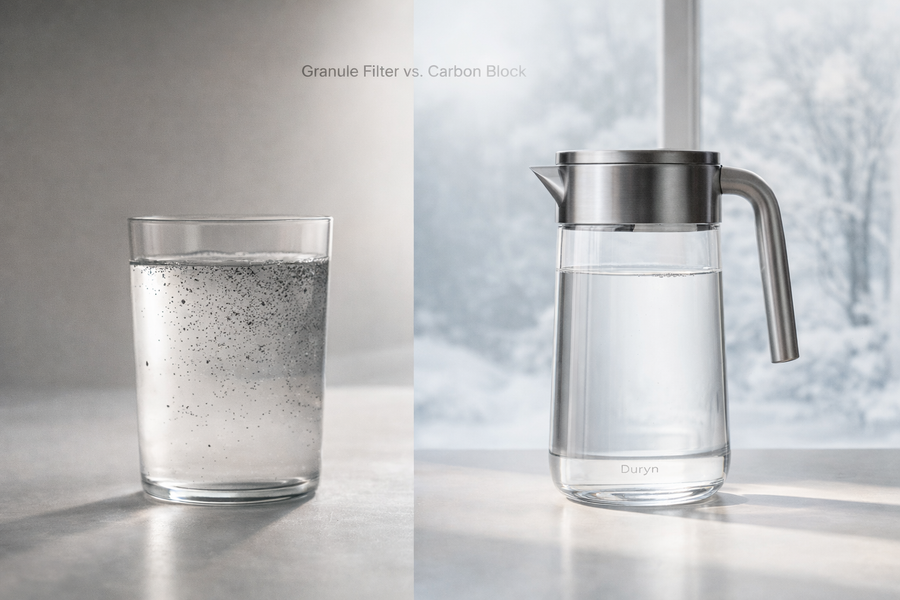
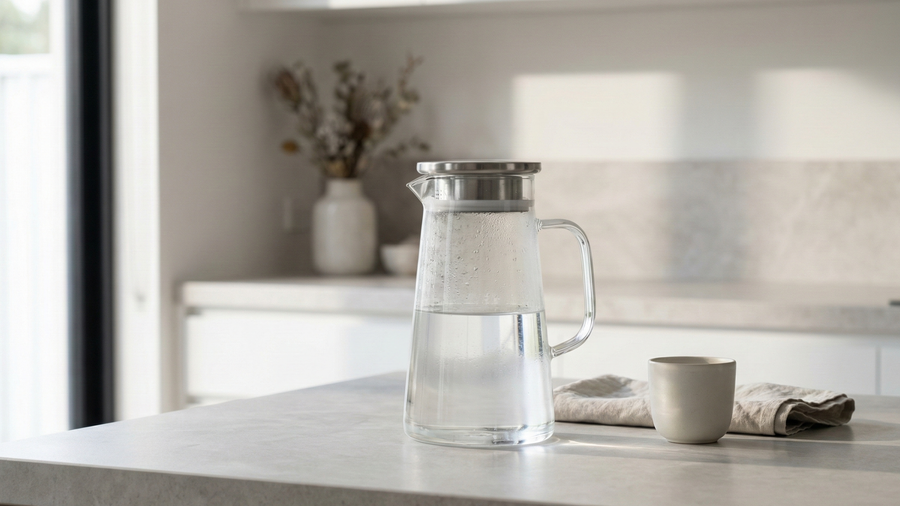
The Journey to Zero: How Duryn Engineered a 0% Plastic Water Filter Pitcher

Walk down the water filter aisle, and you’ll see a sea of plastic.
For years, the industry standard has been "better" plastic—BPA-free, recycled, or recyclable. But at Duryn, we asked ourselves a harder question: What if we used no plastic at all?
We wanted to reconsider the pitcher, reservoir, cartridge and seals together. Duryn One uses borosilicate glass and stainless steel, with food-grade silicone seals and a replaceable cartridge.
Here is the story of how we proved them wrong and achieved the 0% plastic water filter pitcher.
Phase 1: Reimagining the Vessel
The first step was the most obvious, but it required zero compromise on durability. We ditched the standard polycarbonate bodies found in most pitchers.
Instead, we turned to not just Borosilicate Glass, but High Borosilicate Glass.
Unlike standard glass, borosilicate is resistant to thermal shock and incredibly durable. But more importantly, it is inert. It doesn't hold odors, it doesn't stain, and it doesn't leach chemicals. When you pour from a Duryn pitcher, you aren't just seeing clear water; you are tasting water that has never touched a synthetic surface.
To hold the filtration system, we bypassed plastic inserts and utilized medical-grade 316L stainless steel. It offers a sleek, modern aesthetic and remains sanitary forever.
Phase 2: The "Impossible" Filter Cartridge
This was our biggest hurdle. Most "eco-friendly" filters on the market still rely on a plastic casing to hold the carbon media. Even if the carbon is natural, the shell it sits in is often trash.
We had to reinvent the cartridge anatomy from scratch, and we knew that to get to 0%, we had to obsess over the details that most people never see.
The Secret is in the End Caps
In a standard filter, the caps that hold the carbon in place are almost always molded plastic, often glued shut with industrial adhesives. That wasn't good enough for us.
We engineered our cartridge end caps using solid medical-grade 316L stainless steel.
The cartridge is replaceable; the pitcher is designed for repeated use. Follow the fitting and removal instructions supplied with your current cartridge. Replace after 100 US gallons (approximately 379 litres) or 90 days of use, whichever comes first. Higher usage may require an earlier replacement.
The Media
The cartridge uses activated carbon. For the current cartridge specification and model-specific performance, see the product page and testing information.
The result? When your filter is "done," you aren't throwing away a plastic shell. You are simply composting a block of carbon and reusing your precision-machined steel components.
Phase 3: The Seal (The Final 1%)
The final 1% is where most "plastic-free" claims fail. How do you seal the unit to prevent leaks without a silicone or rubber gasket?
We utilized natural food-grade silicone (derived from silica, a natural element) only where strictly necessary for the vacuum seal. However, because our steel-on-glass fitment utilizes such high-tolerance precision engineering, we minimized the need for gaskets, relying on gravity and the perfect fit of the steel components to do the heavy lifting.
Why It Matters
Achieving 0% plastic wasn't just an engineering flex; it was a health and environmental necessity.
-
No Microplastics: By removing plastic from the device, we remove the risk of microplastics degrading into your drinking water.
-
True Circularity: Glass and steel are infinitely recyclable. Our carbon blocks are compostable. The waste footprint of a Duryn user is effectively zero.
The Future is Clear
Building the Duryn pitcher took months of prototyping, shattered glass, and failed molds. But holding the final product—cool, heavy, and crystal clear—made it all worth it.
We believe clean water shouldn't come at the cost of a dirty planet. With Duryn, you finally don't have to choose.